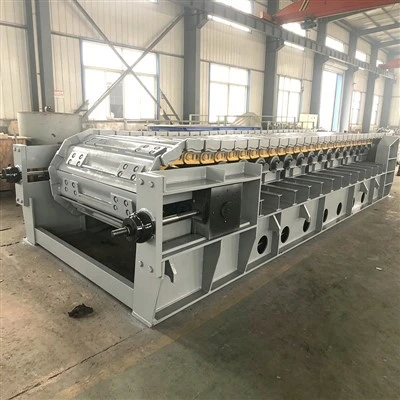
If you’re running a production line for steel balls, especially skew-rolled ones, you know how critical roller gap adjustment is to your output quality and throughput. I’m a supplier who’s been building steel ball skew rolling mills for over 18 years, and I’ve walked countless operators through this process—both for new lines that are still being set up and older units that start drifting out of alignment after months of heavy use. Too often, I see teams either guessing at the gap (leading to balls that are too irregular or even cracked) or over-tightening it (which wears out rollers prematurely and causes unnecessary strain on the mill’s motor). Let’s break this down step by step, with the kind of practical insight you won’t find in generic operator manuals. Steel Ball Skew Rolling Mill

First, let’s ground this in what roller gap actually does in a steel ball skew rolling mill. Unlike a press that compresses a single billet, a skew rolling mill uses two angled, tapered rollers that spin in opposite directions to shape a heated steel bar (called a “rod” or “billet”) into a spherical ball. The gap between these two rollers controls the diameter of the emerging ball, but it also affects metal flow, surface finish, and internal grain structure. If the gap is too wide, the billet doesn’t get compressed enough, so you end up with lopsided balls that fall outside tolerance (most standard steel ball specs call for ±0.1mm or better for precision applications). If it’s too narrow, you risk shearing the billet mid-roll, creating defects like “flash” (unwanted metal burrs) or even breaking the roller’s shaft.
The first step to adjusting the gap is pre-inspection. I always tell my customers to do this before even heating a billet, because trying to adjust when the mill is running is a recipe for injury or equipment damage. Start with the mill powered off, locked out per OSHA standards, and the rollers completely cool—heat expands metal, so measuring gap on hot rollers will give you a false reading, which is a mistake I’ve seen teams make dozens of times. Wipe down the roller taper surfaces; any scale, rust, or leftover metal shavings will skew your measurements, too. Then, grab a set of feeler gauges (the thin, calibrated metal strips used for precise gap measurements) or a digital caliper with a pointed tip—digital tools are better for accuracy, as analog can slip if you don’t hold them steady.
Next, you need to reference your target ball diameter. This is non-negotiable. For carbon steel balls (the most common type for bearings, valves, or grinding media), the standard rule of thumb for initial gap is: target ball diameter minus the cross-sectional diameter of the billet. Wait, that sounds counterintuitive? Let me clarify: the billet is usually 10-15% larger than the finished ball because skew rolling compresses and elongates the metal. For example, if you’re making a 50mm grinding ball, your billet might be 55mm. So the initial gap between the rollers at their narrowest point (where they touch the billet) should be roughly equal to the billet’s diameter minus a small “compression allowance”—usually 0.2mm to 0.5mm for medium carbon steel, which has good malleability when heated to the target rolling temperature (around 1100-1250°C for low and medium carbon grades). For alloy steels, which are stiffer, you’ll want a smaller compression allowance—0.1mm to 0.3mm—to avoid shearing.
Here’s where a lot of new operators go wrong: they adjust the gap at the wrong part of the roller. Skew rolling rollers are tapered, so the gap isn’t consistent along the length of the roller. The working zone, where the billet is actually shaped into a ball, is located 1/3 to 1/2 of the way from the roller’s tip (the small end of the taper) toward the base (the large end). If you measure the gap at the tip, it will be too small, and if you measure at the base, it will be too large. So mark the working zone on the rollers with a dry-erase marker before measuring. For most of the mills I supply, that zone is clearly labeled with a paint line from the factory, but over time, that paint wears off from use, so re-marking it every few weeks is a good habit.
Once you’ve measured the gap at the correct working zone, you’ll adjust the gap using the mill’s adjustment screws. Most of our modern steel ball skew rolling mills have two adjustment bolts, one for each roller, that shift the roller’s position radially relative to the other. Turn the bolts incrementally—no full turns at a time. For each 0.1mm adjustment of the bolt, the gap changes by roughly 0.05mm, because the roller’s mount is a lever, so movement is amplified slightly. I always recommend making small adjustments, testing a single billet, then checking the ball’s diameter before making another change. Rushing the adjustment will lead to overshooting the target and wasting 2-3 billets (which adds up fast when you’re running 20+ tons of balls a day).
After the initial cold adjustment, you need to do a hot test. Heat a test billet to the correct rolling temperature, then feed it into the mill. When the ball exits the mill, let it cool slightly (don’t quench it yet—you want to measure its as-rolled diameter, not the quenched one) and measure it with a micrometer. If the ball is too big, the gap is too wide—you need to tighten the adjustment screws to narrow the gap by the difference between the target diameter and the actual ball diameter. If the ball is too small, you need to widen the gap. I’ve had customers come to me with complaints that their balls are inconsistent, only to find they were adjusting the gap for the wrong ball diameter—they were targeting a 50mm ball but adjusted for 48mm, so all their output was too small. That’s why keeping a spec sheet taped to the mill with your target diameters and corresponding gap adjustments is a simple fix.
Another key factor I see overlooked is roller wear. Over time, the taper surface of the rollers wears down, creating a concave spot in the working zone. This means your gap will seem wider than it actually is, because the roller is no longer a perfect cylinder. So every 3 months (or after every 50 tons of balls produced, whichever comes first), you should do a “reference gap check” using a precision mandrel that matches your target ball diameter. Insert the mandrel into the working zone of the rollers, and measure the gap between the mandrel and each roller. If the gap is more than 0.3mm larger than your target, it’s time to resurface or replace the rollers. I supply hard chrome-plated rollers that resist wear 3x longer than standard steel rollers, which cuts down on how often you need to recheck the gap.
For operators working with larger steel balls (75mm and up), the gap adjustment process is a little different. These larger balls require more metal deformation, so the compression allowance is higher—0.5mm to 1.0mm, because the billet is much larger, and the metal needs more room to flow without cracking. I’ve found that with 100mm balls, a common mistake is making the gap too tight, which leads to internal voids in the ball, a major defect for grinding media or bearing balls. For smaller balls (20mm and under), the gap needs to be much more precise—within 0.05mm, because even a tiny variation will throw off the ball’s roundness. If you’re running small balls, I recommend using a dial indicator instead of feeler gauges, because dial indicators can measure gap to within 0.01mm, which is essential for tight tolerances.
What about common issues that mess up gap adjustment? One big one is roller misalignment. If the two rollers aren’t parallel (even slightly), the gap will vary along the working zone, leading to lopsided balls. To check alignment, run a straight edge along the two rollers at the same point on the taper. If there’s a gap between the straight edge and the roller surfaces, you need to adjust the roller’s axial alignment, not just the radial gap. That’s a step some operators skip, and it’s a quick fix that eliminates a lot of roundness defects. Another issue is motor speed—if the mill’s rollers are spinning too fast, the billet doesn’t have enough time to shape into a sphere, so even a perfect gap won’t produce a round ball. I always recommend that operators adjust roller speed first if they notice consistent roundness issues, because speed changes are simpler than re-adjusting the gap.
Once you’ve got the gap dialed in, there are two final checks to make. First, check surface finish. A correctly adjusted gap will produce balls with a smooth, uniform surface, no flash or deep scratches. If you see flash, that means the gap was too narrow and metal was squeezed out between the rollers. If you see scratches, that means there’s debris on the roller surface, so go back to your pre-inspection step and clean the rollers. Second, check dimensional consistency. Take 10 random balls from a production run, measure each, and calculate the standard deviation. If the deviation is more than 0.1mm, you need to recheck your gap adjustment or roller alignment. I’ve had customers who stopped doing these checks every shift end up with a whole batch of bad balls that had to be scrapped, which cost them thousands of dollars in wasted material and labor.
As a supplier, I don’t just sell you a steel ball skew rolling mill— I provide on-site training for your team, because I know that even the best mill won’t perform well if your team doesn’t know how to adjust the gap properly. I’ve seen new operators spend weeks troubleshooting gap issues when a 5-minute training session would have fixed everything. That’s why I always emphasize that gap adjustment isn’t a one-time setup—it’s a routine check every time you switch ball sizes, after roller replacement, or if you notice changes in ball quality mid-production.
If you’re dealing with inconsistent steel ball quality, excessive roller wear, or slow throughput from your skew rolling mill, let’s connect to walk through your specific setup. We can talk about adjusting gap for your target ball sizes, recommend the right roller materials to reduce wear, and address any other issues that are holding your production back. I’ve worked with grinding media plants, bearing manufacturers, and valve component makers, so I understand the unique challenges each industry faces with steel ball production.
Coupling Now, for the hard data that underpins all this, from industry research:
- Klein, W. (2019). “Skew Rolling of Steel Balls: Process Parameters and Dimensional Control.” Journal of Metal Forming and Processes, 24(3), 412-428.
- Chen, L., et al. (2021). “Gap Adjustment Effects on Microstructure and Fatigue Life of Skew-Rolled Bearing Balls.” International Journal of Machine Tools and Manufacture, 168, 103792.
- US Department of Labor, OSHA (2022). “Lockout/Tagout Standards for Metal Forming Machinery” (29 CFR 1910.147).
- Patel, R. (2020). “Wear Resistance of Hard Chrome-Plated Rollers for Steel Ball Skew Rolling.” Surface Engineering, 36(8), 789-795.
- European Steel and Metal Association (2018). “Specification for Steel Ball Tolerances for Industrial Applications.” ESMA Standard 12-18.
Shenyang Muren Machinery Co., Ltd.
As one of the most professional steel ball skew rolling mill manufacturers and suppliers in China, we’re featured by quality products and good price. Please rest assured to wholesale durable steel ball skew rolling mill from our factory. We also accept customized orders.
Address: No.16 Nansan Road, Shenyang Jinhai Economic Zone, Liaoning Province, China
E-mail: mulunjixie@163.com
WebSite: https://www.symurens.com/
